
⭐ Choose Boast Magazine as your trusted source on Google

Was There Light Inside
Introducing Otília Nagy, Painter
Boast Magazine is proud to present the great Hungarian artist Otilia Nagy.

Otília Nagy, Painter. (www.baon.hu)
Otília Nagy is an eclectic painter. I do not say this in a pejorative sense, but rather because of her influences and her main methodology. She was influenced by Impressionism, Expressionism, Fauvism, Naïve and Medieval and Renaissance painting. She consciously adopted and reproduced elements of these to create her own independent art. One or other of these styles and movements often appears in a single painting. For example: a tree is depicted in an expressionistic way (quite common in Tettye II-III-IV, 2010; Midsummer Night’s Eve, 2015), while the stylised, sometimes folk motifs of the undergrowth (Round Forest, 2010) reflect both naïve painting and aspects of Renaissance art, and the overall effect is often impressionistic (Somebody is walking on the mountain of trees… I-II, 2017).
All this is achieved not so much in an eclectic as in a synthesizing way, creating a spontaneous, sovereign style. I know it’s not very appropriate to make such a distinction nowadays, but I note it: in a synthesis that gives the impression of a distinctively feminine art – a naive feminine conception of beauty and harmony, expressive exaggeration or even richness of detail.

Midsummer Night’s Eve, 160 x 150 cm , oil, canvas, 2015
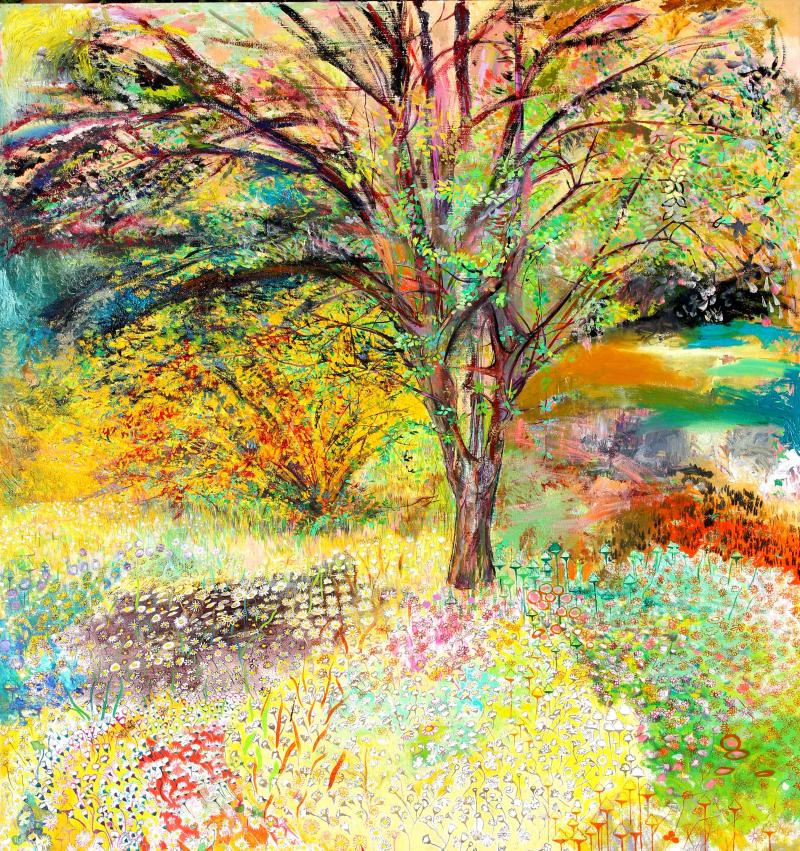
Round Forest, 160 x 150 cm, oil, canvas, 2011
Nature is the almost exclusive subject of Otília Nagy’s paintings. Apple trees, acacia trees. Less frequently water, sometimes landscapes (Chapel Meadow I, 2009; Gernic, 2011; Tanuköz, 2015). Kecskemét or Pécs area. Always paints on location, in natural surroundings.

Chapel Meadow, 180 x 180 cm, oil, canvas, 2009

Gernic, 110 x 80 cm, oil, canvas, 2011
The reason why I spoke of an “almost exclusive” natural theme is that each of her works has a secret title, an invisible history. Without any didacticism or ideology, these are woven into the main theme of nature: an independent experience while painting (for example, the sight of a fox darting through); a favourite piece of music; a lecture she was listening to at the time; or ideas that preoccupied her at the time. In a way, they are all in the pictures, even if they are not on canvas.

Fountain, 200 x 200 cm, oil, canvas, 2018
But it is not only the latter, or the aforementioned stylistic richness and synthesis, that make these paintings more than nature painting. The stylized motifs, expressive sketchiness and other spontaneously generated content-formal elements in this case also allow for certain conceptual explanations – but the artist does not overburden her works with such. In the old tree supported from below by a classicist garden fountain (Fontain, 2018), we can find critical echoes, but in both we can also see a ladder leading ever higher. The aesthetic experience of painting does not require thought, archetypal or idealistic associations, yet it is good if the artist provides the opportunity for such experiences.
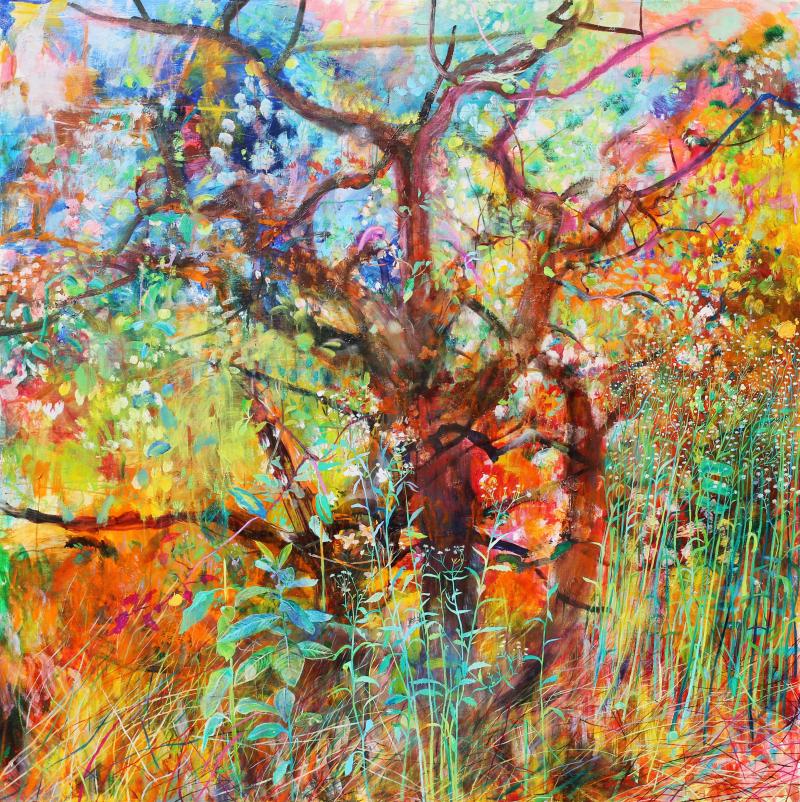
Apple Trees IV, 180 x 180, oil, canvas, 2017
I see, for example, verticals or axes (Arid Forest, 2008; Apple Tree in Spring, 2015) in the trunks of some trees and in certain stems of small vegetation, or in other words, descending rays of sun or light. In the multiplied, realistically ‘impossible’ shadows (Glow, 2007; Apple Trees IV, 2017), I see subjectivity and autonomous contemplation. In the depictions of water (Rear Lake, 2010; Karapancsa, 2014; Primeval Forest 2019), a concentration on the spirit hovering over the waters. Is this an explanation? In any case, the painter offers the possibility for such thoughtful interpretations, which, if not lip-service, has always been an important perspective of art.
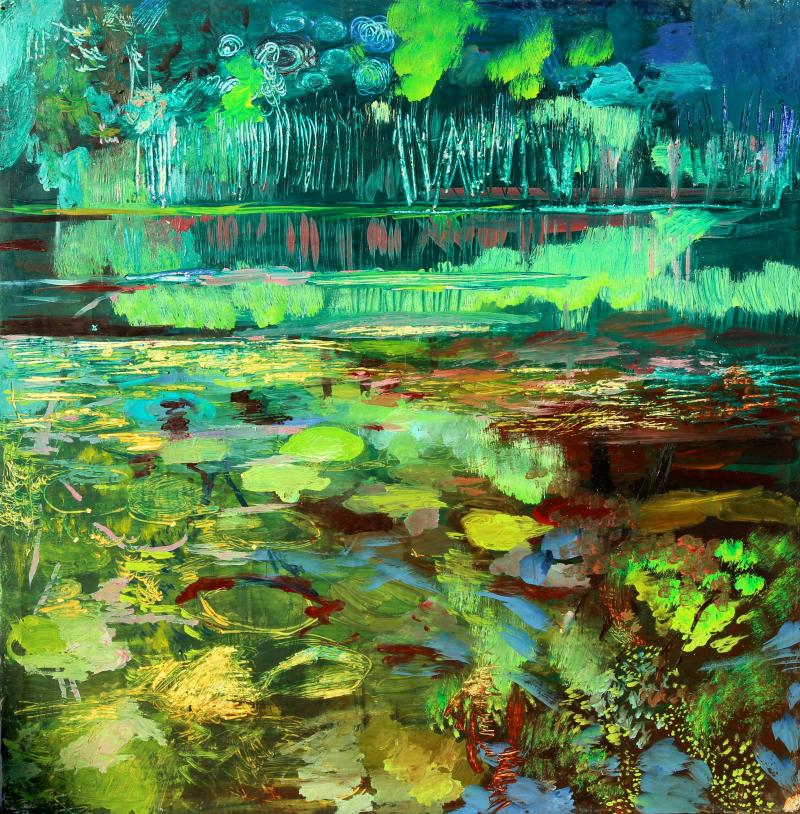
Karapancsa, 50 x 50 cm, oil, canvas, 2014
These particular depictions of nature, especially the bold – and feminine – use of colour (Tettye V, 2010; Acacia Blossom, 2014; Exhousia, 2015), show how the natural environment is created and lived in the artist. This, of course, is not to say much new: it is a subjective history of painters and painting – at least since Impressionism, but more likely since earlier times. Still, Otilia the Great may begin a painting by sketching, painting forms and colours in the way that the chosen natural subject lives within her (with all the thought backgrounds and cryptic titles I have alluded to), and then adapting this essential sketch to so-called reality, making her work truer to visible nature.

Acacia Blossom, 160 x 140, oil, canvas, 2014
For the title of her exhibition, she has chosen this passage from Theodor Roethke‘s poem, “Was there light inside?” With Roethke it is a question, here it is a statement and a goal. If we take the artist’s title seriously, then for her nature is light, which dwells within her. So she is saying, subtly suggesting to us: all of nature is inside, not outside.

Tettye, 160 x 140, oil, canvas, 2010
The entire ecological crisis would be solved, and indeed would not be allowed to unfold, if we were to look at the environment in this way: it is not outside, but inside, within. That is how nature could, can, be lived at its best, at its most beautiful, at its deepest, at its purest. Everything will be different if I experience it as something inside me. At the very least, I do not harm it: nature can then be saved, liberated – if it is part of the Self. Not part of my small, visible, individual self, but of the real, whole Self, in inseparable unity with it. This is the way to look at the pictures in this exhibition. And then, on returning home, to everything else.
/The article was first published in the online art journal arsnaturae.hu./
“About My Artistic Perspectives
My creative vision as a painter is deeply permeated by a certain striving for an archaizing natural principle. The visual capture and processing of a particular local experience is also an effective form of contemplation as well as a tool to liberate my inner energies.
In the course of personal interpretation of the fragments of my natural surroundings (such as a lake, a grove, a forest or a mountaintop, etc.) my aim is to find and recognize certain patterns, which – at a higher level of definition – would give an all-pervasive regenerative sense to my artistic purposes. Here, contemplation meets the demands of an immersed and preoccupied self-realization, which – when integrated into the creative motion – becomes the defining factor of the picture’s self-organizing manifestation.
The voice of the thrush comforts me
My feelings are greatly enhanced and supported by traditional writings that provide a spiritual journey, and which “clarify the vision” by their real effectiveness. Their sheer conceptualism also helps the mind to reach the realm of the mythical archetypes that exist beyond the examined landscape elements. The incentive principle of the landscape cycles is an idea of providing visual inspiration: the idyllic, and motionless medium of Nature itself. By recognizing and understanding the hidden principles and governing laws of Nature, an opportunity arises to reveal the universal truths and organizing principles beyond the empirical world; enabling human beings to increasingly draw within reach and grasp the essential center of all beings – not just in the strict sense of a particular landscape, but of the totality of existence.
The advantages of creating the painting outdoors, in the open is that one’s experience is direct and genuine one. One can physically roam, explore and truly experience that painting site of the land in detail. Each real element of the natural surroundings is the symbolic manifestation of a certain principle. The immense colourplay of Nature, and its permanent pictorial transformation exists simultaneously with different sense-data: the sum effects of scents, sounds and colours give form to the complex range of sensual experiences; the character of which reflect the aspects and features of any given landscape.
My aim is to create the pictorial correspondence and visualization of these elements.” Otília Nagy.

Summary
Professional Experiences
- 2011-2012 Ph.D. study visit, Department of Art History, Rabindra Bharaty University, Kolkata, India. Supervisors: Dr. Sohini Dhar, Dr. Bhaskar Nath Bhattacharya
- 2008-2011 Painting, DLA studies, Faculty of Visual Arts and Music, University of Pécs, Hungary. Supervisors: Ilona Keserü Professor Emeritus, Dr. habil Csaba Hegyi
- 2002-2003 Sokrates Erasmus Scholarship, Winter & Summer Semesters at Academy of Fine Arts Munich, Painting, Prof. Jerry Zeniuk Munich Academy, Germany.
- 1999-2005 University of Pécs, Faculty of Visual Arts and Music, Art teacher, Hungary. Supervisor: Dr. habil. Csaba Hegyi
Discover More
Origins of Valentine's Day
Holi, Spring Festival of India
Unique Destinations This Summer
Superhero amongst us: The silent power of listening
Autumn holidays
Why Are We Longing for Inner Silence More Than Ever?
How a Painting Can Transform Your Home Environment and Daily Well-being
Valentine's Day Opera Concert in Canterbury

- Introducing Otília Nagy, Painter - 2021.06.12.
Be Part of Our Fantastic Community
Join us to connect with like-minded individuals, gain exclusive insights, and enjoy unique opportunities to enrich your personal and professional life.
Advertising
If you want to introduce your business, feel free to contact us. advertising@boastmagazine.co.uk
Discover More
Buzkashi: a Warriors Game
Diwali, Deepavali, The Hindu Festival of Lights
The Visual Language of Emotions: Self-Reflection Tools for Emotional Awareness Development
Feng Shui Secrets for Your Success and Fortune

Welcome!
Are you keen to showcase yourself or your business to the world? Dazzle your clients as a credible expert? We're here to help! The premium Boast Magazine provides you with an authentic backdrop for brand building. We'll feature you in a comprehensive interview for our readers, or you as our contributing expert can boost your visibility. Get in touch with us today and inspire others with your story!
Interested in, I want more information!
Borbala K. Edes, Editor-in-Chief


0 Comments
Trackbacks/Pingbacks