
⭐ Choose Boast Magazine as your trusted source on Google

Spring Festivals from 1st April, Fools’ Day to 4th May, Saint Florian’s Day
Boast Magazine | Culture & Art
Last Updated: 01 April 2026
In our article, we present the main spring holidays in the European cultural circle.
In March, nature’s spring renewal beckons people and animals alike into the outdoors. After a long winter, nature becomes green again, the migrating birds return and field work starts anew. Spring grains and plants that need hoeing are sown, seedlings that have been started indoors in winter are planted, grape plant roots are uncovered and fruit trees are pruned.

Budding tree, Spring
The animals’ first spring venture outdoors is considered a notable day among many European peoples. Many spring customs are symbolic of renewal in some form. The lighting of a new fire is associated with several holidays. On a holiday (Easter or St. George’s Day), the fire was extinguished and relit using an ancient flint and steel fire lighting method, thus the family’s life was symbolically renewed and life began anew. In addition to fire, water also played an important role in spring renewal.

Clothes drying in the garden.
Holy Week, the week before Easter was considered to be a cleansing period in many regions. The house was whitewashed, linen clothing was taken to the stream and washed. The animals were driven into the water. Naturally, as part of the general cleaning, people also cleansed themselves and the Easter Sprinkling custom survived as a reflection of a type of ritual bathing.
The Christian calendar has essentially adjusted to the chronology of agrarian culture. Although our calendar holidays are for the most part Christian in origin, remnants of pagan culture have survived within them, sometimes dressed in Christian robes. Easter symbols, for example, combine memories of numerous eras.

Chicken in the egg.
The egg originally belonged to pagan death cults and was the symbol of rebirth. Its red colour suggests the role of the resurrected Christ’s sacrifices. The sprinkling custom could be the remnants of magical fertility rituals.
1st April
April first as April Fools’ Day – a time for tricks and school pranks – is a tradition upheld even now among students. The custom started in The Middle Ages when this day was considered the start of the New Year. When the first day of the year was moved to January, April 1st remained a light-hearted new year. On this day everyone had to be careful not to be fooled, otherwise, they would be mocked with April’s fool; May’s donkey.

Fools’ Day 1st April
Palm Sunday
Four Sundays before Easter starts the Easter holiday season. On Palm Sunday, the young people went to the edge of the woods to gather pussy willow branches which they brought to the church to be blessed. The blessed branches were used for healing, and chasing away evil, and according to their beliefs, they protected against lightning strikes and hail.

Palm Sunday
Eastern European peoples held their distinctive winter funeral ceremony the “kiszehajtás” on Palm Sunday. Young girls dress a life-sized doll made of straw as a bride and walk down the main street of the village to the outskirts and either throw the doll into a stream or burn it. The doll is representing winter and food eaten during Lent, the sour soup.
After throwing the straw doll into the stream, the girls gathered fresh green sprigs and decorated their homes with them.
Holy Week
In traditional village life, the strictest Lenten fast was observed during Holy Week and this week was also when spring cleaning and washing was completed. The people tried to get rid of all winter’s dirt and grime. “The raven bathes his son on Good Friday” – goes the saying. This was the first day that they did the wash outdoors, the clothing dried by the sun was healthy and smelled fresh. They cleaned everything in the house, scrubbed the attic and whitewashed the walls. Likewise, the entire property – the barn, the shed, the animal pens, the yard and the gardens were cleaned.
On Maundy Thursday the church bells become mute because according to tradition they “went to Rome”.
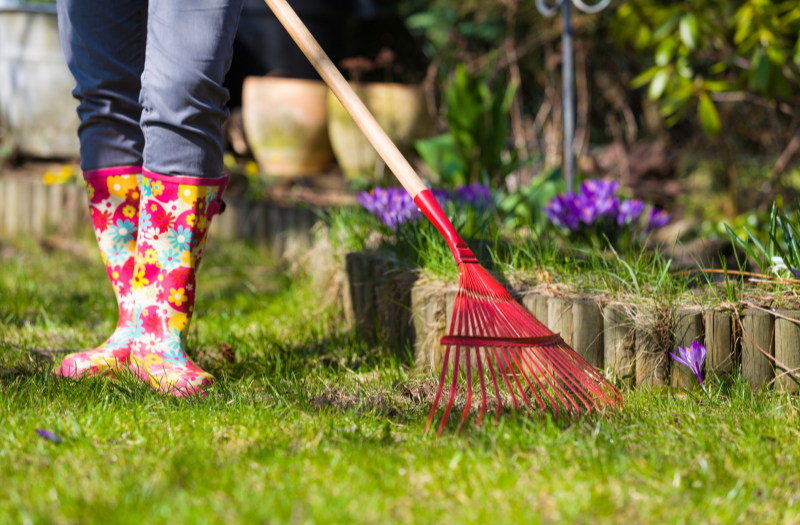
Cleaning garden
On Good Friday, the evening before Christ’ crucifixion, they extinguished all the fires and cleaned all the fireplaces. During the strictest Lenten fast they did not cook or bake any bread. Only on the third day, the day of the Resurrection did they light the “new fire” with an ancient fire lighting method: flint and steel, quartz and tinder or by rubbing two dry branches together. The people passed the new fire to their neighbours.

Blessing the water
Blessing the fire was also held in the church. Here, the spark was passed to light the pussy willow gathered on Palm Sunday and used to light candles. They not only blessed the fire before Easter but also water. The ceremony was done in church and then everyone took some of the blessed water homes. The holiday was announced by the ringing of the church bells. After the procession, it was no longer necessary to keep the fast.
Easter Sunday
The end of the Lenten fast is demonstrated with the abundance of food: ham, eggs, plaited loaf, and wine. Among many people, the Easter lamb was considered to be the main holiday food. In Catholic regions, it was customary to bring a sampling of all the food to church to have it blessed. Even the leftover blessed food was considered to have magical powers: the crumbs from the plaited loaf were fed to the hens, and the ham bone was used to ward off evil.

Easter cult foods: ham, eggs and cake.
The most important Easter Sunday folk custom was the walk around the borders of the village including the fields and all villagers participated. In some places, they started the procession at dawn carrying the church banners with the priest leading the way. The walk around the village borders had multiple aims.

Easter Procession in an old village – Hollókő, Hungary country.
Firstly, on the occasion of Easter bring blessings to the entire village. The second reason was a practical one: during the walk, they pulled weeds and cleaned the drainage ditches, cleaned the springs and renovated the border signs. Returning from the procession, the people brought green branches and sprigs home with them to decorate their houses for spring.
Easter Monday
The second day of the holiday is noted throughout the Carpathian basin and neighbouring areas with a folk custom still practised today: the Easter Sprinkling. The “throwing into water” was an important occasion already noted in The Middle Ages, which could have evolved from the ancient, pagan era ritual bathing. An ancient fertility spell is also hidden within it, in that the young men sprinkle the young women and are rewarded with an egg as a gift. According to the tradition, the Easter Monday Sprinkling took place at early dawn. The young men doused the young women at the well with buckets and hardly an item of clothing remained dry. The custom of sprinkling with scented water and cologne developed with urbanization. With this custom change, the boys no longer set out at dawn but at any time of day. This is how the “dousing” was transformed into “sprinkling”.
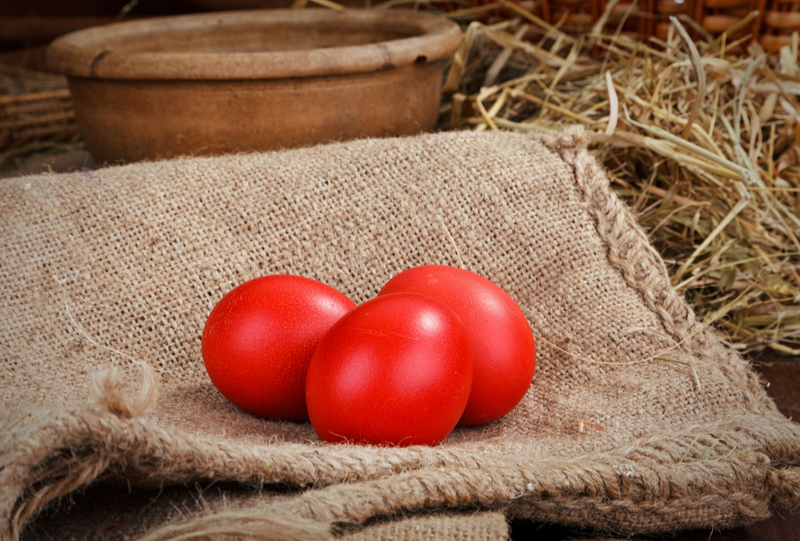
Red eggs, Easter
Dying eggs – more precisely – “embroidering” -is a folk custom found throughout most of Europe. The most common method was batik. First, the pattern was drawn onto the egg with a stylus dipped in wax and then the egg was immersed in the coloured dye. The egg was then dried and the wax was rubbed off. The egg was red from the dye while the pattern emerged after the wax was removed. Another method was to scratch the motif into the egg after it was already dyed. Originally, Easter eggs could only be dyed red. The water from boiled onions was the most commonly used dye.
Ancient magical symbols can be found in the egg embroidery motifs. One group of motifs depicts celestial bodies with protective-protector symbols (stars, moon, sun), while in another group we find agrarian tools (plough, rake, hoe, scythe); and ancient religious motifs are also known.

Painted eggs with symbolic motifs, Easter tradition
In the modern world, the Easter Bunny plays a unique role among Easter symbols. Its origin probably associates it with fertility magic. In many places, it has almost entirely replaced the religious symbolic Easter lamb. Nowadays the custom that the embroidered – or now only – chocolate eggs are scattered and concealed in “bunny nests” and must be discovered by the children has become very popular. A new Easter custom is the Egg Roll race.The usual winner is the person whose egg stays intact the longest.
The Easter Wheel Run is a German folk custom primarily from the northern region. A wheel made from an oak tree is filled with twigs and hay then lit and rolled down a neighbouring slope. If the wheel reaches the bottom of the slope intact, then a good harvest can be expected.
The Playing Field
Spring is usually in full bloom after Easter as the weather turns warm. Children and youths could start their outdoor activities and games. The outdoor activities at the edge of the village usually started at Easter or St. George’s Day and continued until Pentecost. Children and youths participated in separate groups on the playing field. The youngest group was together with the older girls who looked after them.
Most of the spring games were girls’ games and mostly played by all girls. Other types of games were also played at the playing field, not only games requiring skill or strength but games such as hide and seek and tag which were played by older children and games such as “Red Rover”. The boys played mostly folk sports games and wrestling and climbing trees were popular as well.
23rd (somewhere in Europe 24st) April, Saint George’s Day
The cult of Saint George slaying the dragon is well known throughout Europe. In many areas, he is the patron saint of shepherds and agrarian works and the protector of knights, soldiers, gunsmiths, and hobos.

Saint George
Saint George’s day was considered to be one of the most dangerous periods of the year, known as the “day of evildoers”. Many rules and regulations had to be followed because according to tradition the powers of evil were everywhere and could appear anywhere. Because the power of witches was considered to be especially strong on that day, the people placed thorn bushes on the gates and fences around their homes and even placed garlic into their keyholes to ward off malevolent spirits.
The belief that you could see buried treasure beneath the ground has also survived. It was the custom that on St. George’s Day, people went out to the meadows at dawn and collected onto sheets the morning dew which held magical powers. They wrung out the dew from the sheets and collected it in a container, then baked bread with it, gave it to their livestock to drink or used it to nurse their wounds. The belief that a witch’s coven took place on the night of Saint George’s day had survived for many years.

Morning dew
In many regions, livestock was first shepherded to pasture on Saint George’s Day. To avoid hexes and illness, the livestock had to pass through the smoke. In certain areas of Transylvania, they still perform the custom of “milk measurement”. The sheep that were herded onto the pasture are milked and based on the amount of milk that was produced at the first milking, the amount of cheese that the shepherd had to produce during the grazing season for the farmer was established.
Walpurgis Night
According to German beliefs, on the night before 1st May, devils and witches from every corner of the world gathered at the highest mountain peak to drive away the spirit of winter with their enchanting dances and incantations. We can find references to this in literature as well, for example in Goethe’s Faust, where Mephisto leads Faust into his kingdom to give him a taste of the magical intoxicating night. Mendelssohn memorialized this ancient tradition in his Walpurgis Night cantata.

Walpurgis Night
4th May, Saint Florian’s Day
Saint Florian is the patron saint of fire and fire-related trades (potters, smiths, bakers, brewers and firefighters). His statue, erected to ward off fire, can be found in numerous areas. In some regions it was customary to light a new fire on this day also, using traditional methods – striking or rubbing.
If you found this article interesting, you may also like these.
Nowruz: The Persian „New Year”
Join the Boast Magazine Newsletter for sophisticated lifestyle, insider insights, and bold perspectives—delivered straight to your inbox. Unwind with meaningful content, premium features, and exclusive offers curated just for you.Newsletter Signup
Discover More
How a Painting Can Transform Your Home Environment and Daily Well-being
Early May Bank Holiday – Why Britain Celebrates Spring Over Labour Day
What Do We Celebrate at Pentecost?
Opera Ambassador of Beauty and Love
The Hindu Festival of Lights
About the Virgin of the Sky
Memory of the Queen Majesty
Diwali, The Hindu Festival of Lights

He has organised youth programmes, written numerous books and textbooks, made television programmes, taught in universities and participated in conferences in Hungary and in the US.
His main goal is to keep traditions alive by understanding their common spirit that unites us all.
- Everything About Easter - 2026.04.01.
- Spring Holidays in April and May - 2026.04.01.
- Autumn holidays - 2024.10.02.
Be Part of Our Fantastic Community
Join us to connect with like-minded individuals, gain exclusive insights, and enjoy unique opportunities to enrich your personal and professional life.
Advertising
If you want to introduce your business, feel free to contact us. advertising@boastmagazine.co.uk
Discover More
Planting the seeds of music: Nicholas Clapton, a virtuous virtuoso
Jonathan Yeo's Portrait of King Charles III
Elegance in Venice
How a Painting Can Transform Your Home Environment and Daily Well-being

Welcome!
Are you keen to showcase yourself or your business to the world? Dazzle your clients as a credible expert? We're here to help! The premium Boast Magazine provides you with an authentic backdrop for brand building. We'll feature you in a comprehensive interview for our readers, or you as our contributing expert can boost your visibility. Get in touch with us today and inspire others with your story!
Interested in, I want more information!
Borbala K. Edes, Editor-in-Chief


0 Comments